How Spectio works
Spectio sits between you and your workflow engine. It does not replace Nextflow or Snakemake: it launches them on your cluster, follows them through their own events, explains failures, and relaunches them. Most pipelines simply run from start to end. Gates, stops between stages for a quality check, are optional.
Five words
| Word | What it means |
|---|---|
| Run | One execution of a pipeline, with its parameters, samples and outputs. |
| Stage | A group of steps in a pipeline: for example qc, then align, then quantify. |
| Gate | Optional. A stop between two stages. The run waits there until someone decides. |
| Decision | Approve, exclude samples, change a parameter and rerun the stage, or stop. A person, an AI agent or a robot can decide. |
| Runner | The small program next to the compute (a SLURM login node, a Kubernetes cluster, a laptop) that starts the engine and reports back. |
A run without gates
- Launch from the web form, the CLI or the API, on the environment you choose.
- Watch its stages, tasks, samples and logs, and what the scheduler does with its jobs.
- When something fails, Spectio tells you why (out of memory, out of time, a tool error, a node lost) and proposes a change. Relaunch: finished work comes back from the cache.
- When it finishes, outputs, reports and logs stay attached to the run, and can be handed to depictio.
A run with a gate (optional)
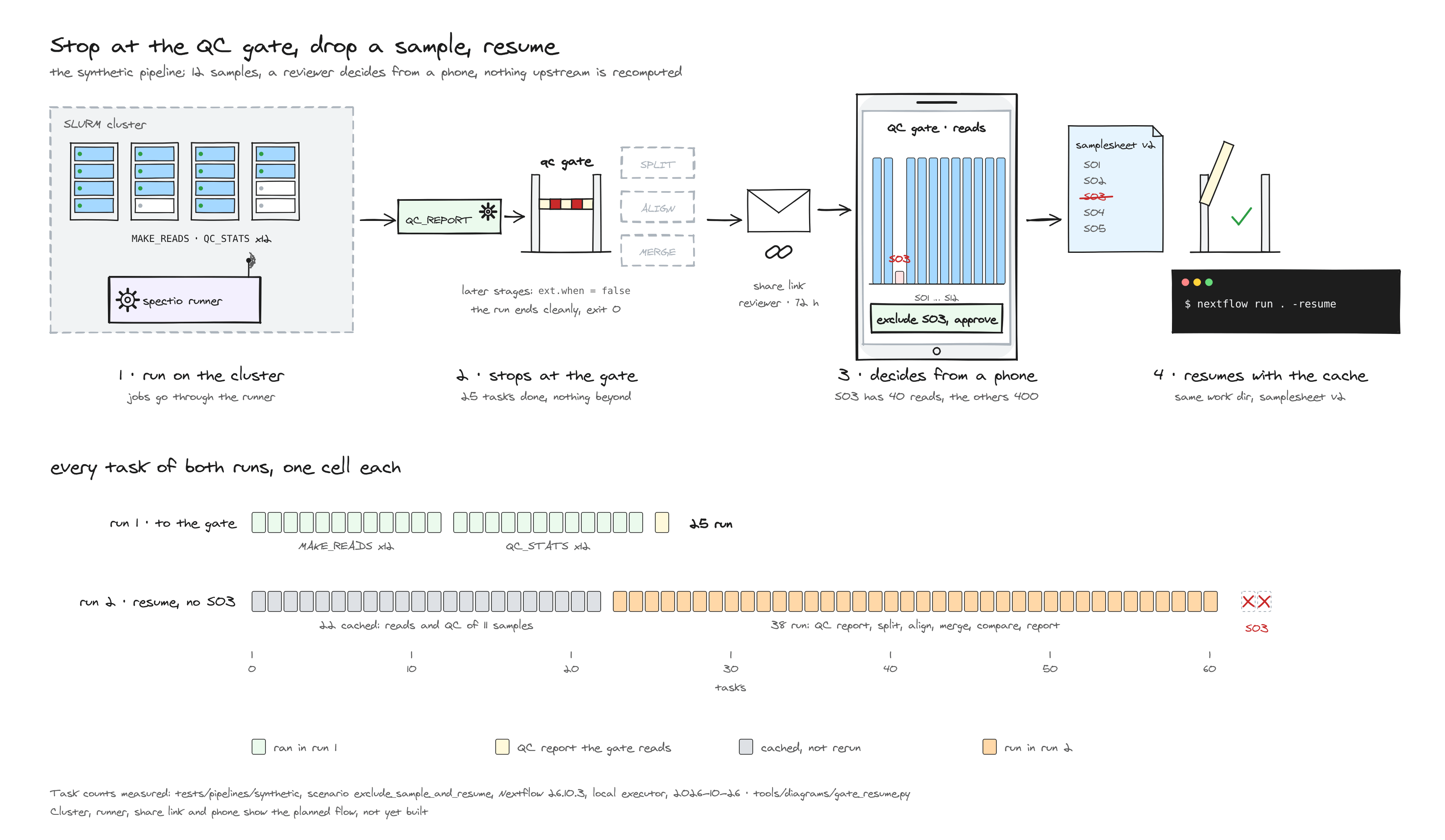
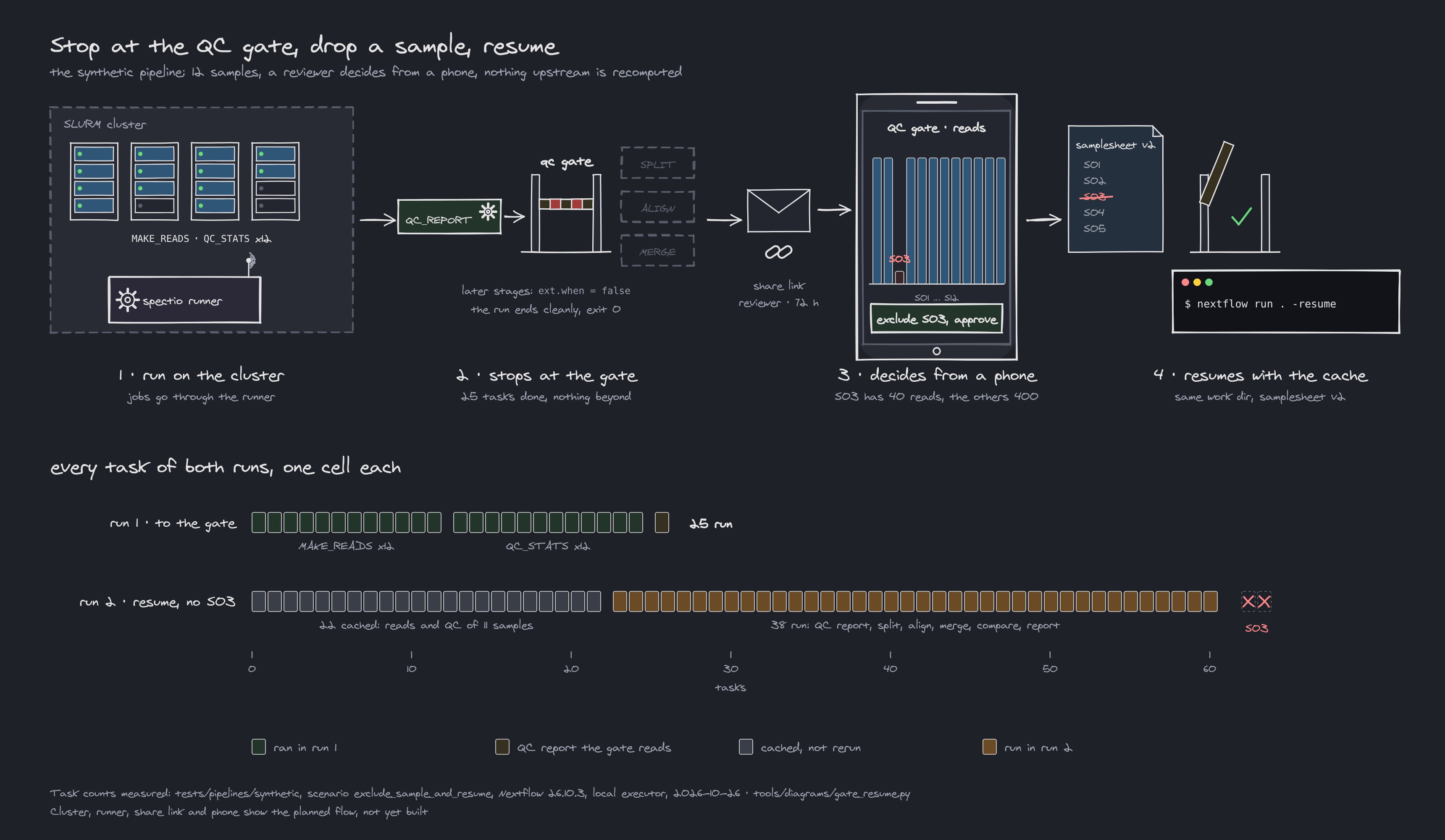
- Launch. You pick a pipeline and its parameters, and say "stop after qc".
- Stop at the gate. Spectio uses the engine's own way of stopping, so the run ends cleanly after qc.
- Decide. The gate shows the QC evidence. Here, sample S03 has 40 reads instead of 400, so the reviewer excludes it and approves.
- Resume. Spectio starts the engine again with the new samplesheet. Everything already computed comes back from the cache.
This has been tested on a small test pipeline with both engines: after the QC gate, 25 of the 65 tasks come back from the cache. The cluster, the runner and the phone in the figure are the planned flow; they are not built yet.
What it looks like in a terminal
The same stop and resume, with Snakemake, recorded from a real run:
Next
- Features: what each part does.
- API and CLI: doing it without the web interface.